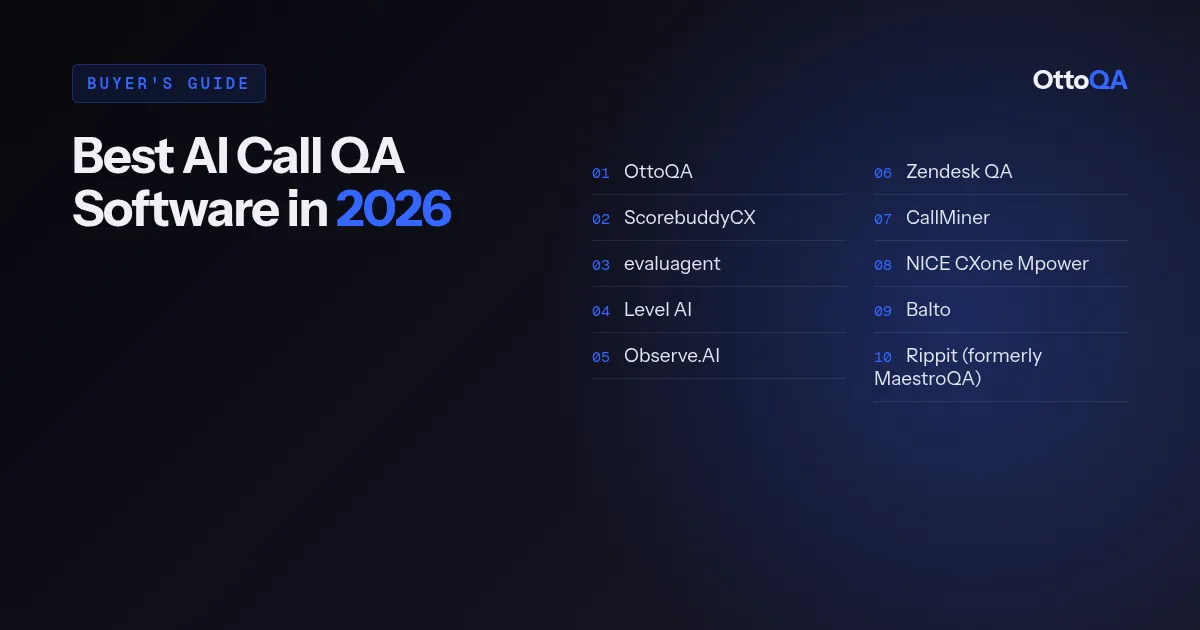
Disclosure: OttoQA publishes this guide, and OttoQA is on the list. We have tried to be fair to everyone else, including saying where another tool is the better choice. Every competitor fact links to where we found it. Prices and packaging change often, so confirm with the vendor before you buy. Last checked October 23, 2026.
500+ agents wanting one platform: shortlist CallMiner, Observe.AI, Level AI and NICE CXone.
Either way: test every finalist on the same 100 to 200 calls your team has already scored.
How we picked
We run a 600+ seat BPO, so we judged these tools the way an operations leader would. Seven questions mattered most:
- Your form or theirs. Can it score against the QA form you already use, or do you have to rebuild it?
- Evidence. Does each score point to the part of the call that justifies it?
- Calibration. Can your QA team compare AI scores to human scores and correct the AI?
- Coaching. Does scoring turn into something a supervisor can act on this week?
- Pricing model. Per seat, per evaluation, or bundled into a phone platform? Is any price published?
- Time to live. Days, weeks, or a project plan?
- Fit. Who is the tool actually built for?
Quick picks
| Tool | Best for | Pricing (as published) | Model |
|---|---|---|---|
| OttoQA | Voice contact centers and BPOs that want calls scored against their own QA forms without a platform project | From $800/mo for 500 evaluations, $1,000 one-time setup (ottoqa.com/pricing) | Per evaluation, month to month |
| ScorebuddyCX | Mature QA programs that want configurable scorecards plus a learning module | Quote only; Foundation, Accelerate, Elite tiers; 14-day trial | Per user, annual |
| evaluagent | Teams that want a published per-user price and structured coaching | From $35/user/mo; $65 with Conversation Intelligence (evaluagent.com) | Per user |
| Level AI | Mid-market and enterprise centers that want QA, agent assist and virtual agents from one vendor | Not published (thelevel.ai) | Quote |
| Observe.AI | Large voice-first enterprises adding AI voice agents | Custom, no public tiers (observe.ai) | Quote, annual by default |
| Zendesk QA | Support teams already running Zendesk | Workforce Engagement bundle (QA, WFM, coaching) $50/agent/mo billed annually, on top of a Zendesk plan (zendesk.com) | Per agent, add-on |
| CallMiner | Compliance- and analytics-led enterprises | Packages by user count or interaction volume, from midsize teams of 60+ agents (callminer.com FAQ) | Quote |
| NICE CXone Mpower | Replacing your whole contact center platform, or already on NICE | Suites from $110 to $249/agent/mo; quality management and screen recording are part of its suite lineup; confirm which suite includes the QA features you need (nice.com/pricing) | Per agent, full CCaaS |
| Balto | Real-time in-call guidance | Per seat, contact for pricing (balto.ai/pricing) | Per seat |
| Rippit (formerly MaestroQA) | Helpdesk and CX insights teams | Free plan (100 agent runs), Starter $185/mo, Growth $495/mo, Enterprise custom (rippit.com/pricing) | Per agent run |
Enterprise vs. small and mid-size contact centers
Company size changes what you need more than any feature list does. A 2,000-seat bank and a 60-seat BPO can both say "we want AI QA" and mean very different things.
Small and mid-size centers and BPOs (roughly 10 to 500 agents)
This is who OttoQA was built for. These teams usually have one to three QA analysts hand-scoring a few calls per agent per month, no spare IT capacity, and a budget that has to be justified against analyst salaries.
- What they need: a published price, no seat minimums, month-to-month terms, setup done for them, and results in days rather than a quarter.
- What matters most: scoring against the forms they already use (often in Excel), and coaching a supervisor can use on Monday.
- BPOs specifically: many clients, many forms, and headcount that rises and falls with campaigns. Per-evaluation pricing avoids paying for seats during slow months.
- Good fits: OttoQA, evaluagent, ScorebuddyCX, Zendesk QA (if you already run Zendesk), Rippit (helpdesk-based support teams).
- Usually a poor fit: platforms that start at 60 to 100 agents, require annual prepaid contracts, or need a dedicated admin to build rules and queries.
Enterprise contact centers (roughly 500+ agents)
Large, often regulated operations buy differently. Procurement, security review and IT are involved, and the goal is often one platform for many jobs.
- What they need: real-time agent assist, screen recording, SSO and role controls, data residency, analytics across millions of interactions, and deep CCaaS and CRM integrations.
- Good fits: CallMiner, Observe.AI, Level AI and NICE CXone. These are built for this buyer and priced for it.
- Where OttoQA fits in an enterprise: a department or line of business that needs form-based QA running quickly, or a QA and coaching layer next to an existing analytics platform. Above 10,000 evaluations a month, OttoQA pricing is custom.
| Tool | Typical customer size | Why |
|---|---|---|
| OttoQA | 10 to 500 agents; BPOs of any size | Usage pricing, no seat minimum, done-for-you setup |
| evaluagent | Mid-market to enterprise | Published per-user pricing, structured coaching |
| ScorebuddyCX | Mid-market | Dedicated QA with LMS; tiered annual plans |
| Zendesk QA | Any size, Zendesk customers only | Add-on to a Zendesk plan |
| Rippit | Small to mid-size helpdesk teams | Free and self-serve plans, usage-based |
| Level AI | Mid-market and enterprise | Broad suite, quote only |
| Observe.AI | Enterprise | Annual contracts, guided enterprise onboarding |
| CallMiner | 60+ agents up to global enterprise | Packages by users or volume |
| NICE CXone | Enterprise, or anyone replacing their phone platform | Full CCaaS priced per agent |
The pricing model matters more than the price
AI QA tools charge in one of three ways, and the right one depends on how many agents you have and how many calls you want scored.
- Per seat. You pay for every agent, whether you score two of their calls or two hundred. Predictable, but the bill grows with headcount. Examples: evaluagent, Zendesk QA, ScorebuddyCX, Balto.
- Per evaluation or usage. You pay for the work done. Costs follow volume, not headcount, which suits BPOs with seasonal or part-time staff. Examples: OttoQA (evaluations), Rippit (agent runs).
- Bundled with a platform. QA comes as part of a contact center platform or analytics suite. Good value if you need the whole platform, expensive if you only need QA. Examples: NICE CXone, and the enterprise suites from CallMiner, Observe.AI and Level AI.
A worked example using only published list prices: a 50-agent center that wants 10 calls scored per agent per month needs 500 evaluations.
| 50 agents, 500 evals/mo | Monthly list price | Notes |
|---|---|---|
| OttoQA | $800 | Plus $1,000 one-time setup. Same price at 20 agents or 80. |
| evaluagent | From $1,750 | 50 × $35. Volume discounts available. |
| Zendesk QA | $2,500 | 50 × $50, billed annually, plus your Zendesk plan. |
| NICE CXone Essential | $6,750 | 50 × $135 (Essential Suite list price). Confirm which suite includes the QA features you need. This also replaces your phone system. |
Per-seat tools usually let you score far more than 10 calls per agent for the same price, so if you want to score every call, model that too. The point is to run both numbers at your real headcount and real volume before a sales call sets the frame.
Tool by tool
OttoQA
The problem it solves. In a typical 50-agent center, one or two QA analysts listen to a few calls per agent each month, fill in the form, and try to find time to coach. Most calls are never heard, scores arrive weeks late, and supervisors coach from memory. OttoQA was built inside Expivia, a 600+ seat BPO, to fix that exact problem in its own operation.
How it works. OttoQA scores calls, chats and emails against the QA forms you already use, including forms kept in Excel. Send us your form and OttoQA's QA specialists build it into the platform, question by question, so each one is scored the way your best analyst would score it. They score 200 of your calls, you compare the results with your own team's scores, and they calibrate until the scores match your standard. From then on, every evaluation shows each answer, the score and the AI's reasoning.
What supervisors get every week. A coaching plan for each agent tied to specific calls, call summaries, behavior trends (empathy, compliance, sentiment) and predicted CSAT and NPS. Agents who miss a scenario can practice it in Redo, an AI role-play tool, before their next shift. OttoQA reports 95% AI scoring accuracy; the proof of concept is where you check that on your own calls.
Your first 30 days
- Day 1: 15-minute demo, then send your QA form and a batch of recordings.
- Week 1: OttoQA converts the form and scores 200 calls. You compare against your own scores.
- Week 2: Calibration. Questions where the AI and your team disagree are reworded or adjusted.
- Weeks 3 to 4: Live scoring and the first weekly coaching plans in supervisors' hands.
What it costs a smaller center
Pricing is per evaluation, not per agent: $800 a month for 500 evaluations, plus $1,000 one-time setup that covers the proof of concept. Month to month, with 5% off a 6-month term and 10% off 12. A 50-agent center scoring 10 calls per agent pays the same whether it has 50 agents or 80, and a BPO doesn't pay for empty seats in slow months.
For comparison, at 20 to 30 minutes per manual evaluation (listen, score, write notes), 500 evaluations is roughly 170 to 250 analyst hours a month, more than one full-time person. Put in your own numbers with the savings calculator.
Watch-outs: OttoQA scores after the call. It does not give agents live prompts, record screens or route calls. Above 10,000 evaluations a month, pricing is custom.
Best for: contact centers from about 10 to 500 agents and BPOs of any size that want QA running in weeks, with no seat licenses and no IT project.
ScorebuddyCX
A long-standing dedicated QA platform. It claims AI auto-scoring of 100% of conversations across voice, chat and email with 90%+ accuracy, plus a "QA for Bots" module for chatbot conversations and coaching built on frameworks like GROW. Its LMS lets a low score route straight into a training assignment.
Watch-outs: no published dollar amounts. Third-party reviews report AI scoring is capped by plan credits, and the LMS and extra AI credits are add-ons. Confirm how many AI scores your tier includes.
evaluagent
One of the few vendors that publishes prices: $35 per user per month for AutoQM & Improvement and $65 with Conversation Intelligence (sentiment, predicted CSAT and NPS, topic detection). AI agent conversations are priced separately per conversation. Strong on structured coaching: one-to-ones, performance plans, gamification and eLearning. Both tiers include a customer success manager and onboarding.
Watch-outs: per-user pricing scales with headcount, and there is no free plan.
Level AI
Level AI's QA engine, QA-GPT, scores against your existing scorecard or a library of pre-built questions. It supports hybrid scorecards (AI scores objective questions, humans score subjective ones), conditional N/A by call type, transcript evidence with timestamps, and evaluator overrides that feed back into future scoring. QA sits alongside agent assist, virtual agents, voice of customer analytics and screen recording.
Watch-outs: quote only. A broad suite is more than you need if you only want QA. Full comparison →
Observe.AI
An enterprise contact center AI platform. Auto QA scores interactions against your forms with a rule builder, cites the moment in the call behind each answer, and supports calibration between AI and human scorers. Observe.AI also sells real-time agent guidance and AI voice and chat agents.
Watch-outs: custom pricing with annual billing in advance by default, and guided enterprise onboarding. Full comparison →
Zendesk QA (formerly Klaus)
QA built into Zendesk. AutoQA covers Zendesk conversations, including Zendesk Talk calls through Voice QA (Zendesk help), with custom scorecards, calibration sessions, disputes and coaching assignments. Zendesk lists its Workforce Engagement bundle (QA, WFM and coaching) at $50 per agent per month, billed annually.
Watch-outs: requires a Zendesk Support or Suite plan. Only recorded calls are transcribed for QA, at $0.01 per minute (Zendesk help). If your calls run through a separate phone system, they come in through Zendesk Talk Partner Edition, so check what your system can send.
CallMiner
CallMiner Eureka is a conversation intelligence platform used heavily for compliance and analytics. It offers fully automated or hybrid scoring, real-time agent guidance, coaching workflows, dashboards and screen recording, and says AI capabilities are included in all packages. CallMiner states most customers go live within weeks.
Watch-outs: no public price list, and packages start at midsize teams of 60+ agents. Full comparison →
NICE CXone Mpower
A full cloud contact center platform: routing, recording, workforce management, quality management and NICE's Enlighten AI. Published suites run from $110 to $249 per agent per month, with the full AI suite in Ultimate ($249 plus $0.25 per AI session). Quality management and screen recording are part of the lineup; confirm on nice.com/pricing which suite includes the QA features you need.
Watch-outs: this is a platform decision, not a QA decision. It makes sense if you are replacing your phone system anyway.
Balto
Balto is known for real-time guidance: prompts and checklists on the agent's screen while the call is happening. If your main problem is agents missing disclosures or rebuttals live, a real-time tool addresses that directly. Priced per seat; contact Balto for pricing. Many centers pair a real-time tool with post-call QA rather than choosing one.
Rippit (formerly MaestroQA)
MaestroQA rebranded to Rippit in early 2026 and now calls itself "The AI Conversation Data Platform." It focuses on running AI agents over conversation data for churn risk, chatbot monitoring, product feedback and coaching. Pricing is published and usage-based by agent runs, with AI credits charged at cost. Existing MaestroQA rubrics and integrations carried over.
Watch-outs: its listed connectors lean toward helpdesks and conversation tools: Intercom, Decagon, Gong and Granola (rippit.com/pricing), with Zendesk named in its rebrand announcement. Voice centers should confirm phone system support. Full comparison →
When OttoQA is not the right choice
- You need live, in-call prompts for agents. Look at Balto, Cresta, Level AI or CallMiner.
- You are replacing your phone system and want QA in the same contract. Look at NICE CXone or Genesys.
- You are a chat-only support team that lives inside Zendesk. Zendesk QA is the shortest path.
- You need screen recording as QA evidence. Look at Level AI, CallMiner or NICE.
- You are a large enterprise that wants one vendor for QA, analytics, agent assist and AI agents under a single contract. Look at Level AI, Observe.AI or CallMiner.
How to run a fair bake-off
Vendor accuracy numbers are measured on the vendor's data. The only number that matters is how often the AI agrees with your best QA analyst on your calls.
- Pick 100 to 200 calls your team has already scored. Include easy calls, angry customers, transfers, long holds and non-English calls if you take them.
- Give every vendor the same calls and the same form. Don't let anyone swap in their own sample.
- Measure agreement per question, not per call. A tool can match your overall score while getting your compliance questions wrong. Look hardest at auto-fail and compliance items.
- Read the evidence. For every disagreement, check whether the AI or the human was right. Sometimes it is the human.
- Test the correction loop. Change a question's wording or a scoring rule and see how fast the AI reflects it.
- Price it at your real volume and headcount, including setup, minimums, billing terms and what happens at renewal.
OttoQA's 200-call proof of concept follows this structure and is covered by the $1,000 setup fee.
Questions to ask every vendor
- Can you score our current form as written, or do we have to rewrite it?
- What is the minimum contract length and minimum seat count?
- Is billing monthly, or annual in advance?
- What does setup cost, and who does the work?
- How do our QA analysts correct a wrong score, and does the correction change future scoring?
- Can we export our evaluations and scores if we leave?
- Where is call audio stored, and how are PII, PHI and card data redacted?
Frequently asked questions
What is the best AI call QA software for a small contact center?
For centers under about 60 agents, look for published pricing, no seat minimums and a short setup. OttoQA (from $800/mo, usage-based, month to month) and evaluagent (from $35/user/mo) both publish prices. Several enterprise platforms state or are reported to have minimums of 60 to 100 agents.
Which AI QA tools publish their pricing?
As of October 2026: OttoQA, evaluagent, Zendesk QA (as a bundle), NICE CXone and Rippit. Level AI, Observe.AI, CallMiner, ScorebuddyCX and Balto are quote only.
Can AI QA use my existing scorecard?
Most current tools say yes, including OttoQA, Level AI, Observe.AI and evaluagent. The difference is how much rework is needed and who does it. With OttoQA, the team converts your form during setup.
Sources (checked Oct 23, 2026): ottoqa.com/pricing; callminer.com pricing FAQ; thelevel.ai QA page; observe.ai Auto QA page and subscription agreement; rippit.com/pricing; evaluagent.com pricing; zendesk.com/pricing; nice.com/pricing; balto.ai/pricing. ScorebuddyCX plan details from Capterra and vendor comparison pages, since Scorebuddy does not publish prices.
Related reading
- Call Center QA Software
- OttoQA vs CallMiner
- OttoQA vs Level AI
- OttoQA vs Observe.AI
- OttoQA vs MaestroQA (Rippit)
- AI Call QA FAQ
- The Ultimate Guide to Call Center Quality Assurance
- How Many Contact Center QA Evaluations Do You Need Per Agent?
- 12 Common Call Center QA Mistakes and How to Fix Them
About the author
Tom Laird is the founder of OttoQA and CEO of Expivia, with about 30 years in contact centers. He hosts the Advice from a Call Center Geek podcast. Connect with Tom on LinkedIn.