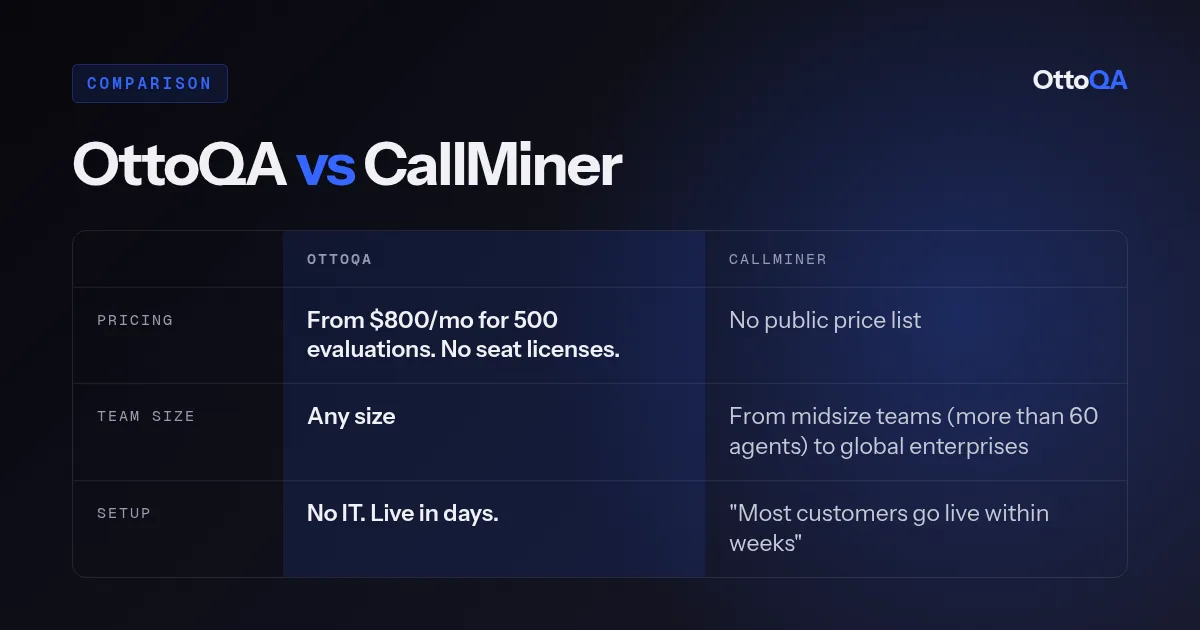
Short answer: CallMiner is an enterprise conversation intelligence platform. It analyzes interactions at scale for compliance, analytics, real-time agent guidance and automated scoring, and sells packages starting at midsize teams of 60+ agents. OttoQA is a focused QA product: it scores calls against your existing QA forms, generates weekly coaching plans, and is priced per evaluation from $800 a month with no seat licenses.
OttoQA publishes this comparison. CallMiner facts come from callminer.com and are linked inline. Checked October 23, 2026.
Side-by-side comparison
| OttoQA | CallMiner | |
|---|---|---|
| What it is | AI QA for contact centers | Conversation intelligence and automation platform (Eureka) |
| Scoring | Automatic, against your existing QA forms (Excel works). Statistical sampling or far more of your calls. | Fully automated quality forms, or automated plus manual as a hybrid (callminer.com) |
| Channels | Voice, chat, email, help desk | Voice and text channels |
| Real-time guidance | No. Scores after the call. | Yes |
| Screen recording | No | Yes (Screen Record) |
| Coaching | Weekly coaching plans generated automatically; Redo AI role-play for practice | Coaching workflow, agent and supervisor dashboards |
| Pricing | From $800/mo for 500 evaluations. No seat licenses. (ottoqa.com/pricing) | No public price list. Bundled packages based on user count or interaction volume; AI included in all packages (callminer.com FAQ) |
| Team size | Any size; pricing follows evaluations, not agents | From midsize teams (more than 60 agents) to global enterprises |
| Setup | $1,000 one-time. No IT. Live in days. | "Most customers go live within weeks" (callminer.com FAQ) |
| Try it | 200-call proof of concept, covered by setup | Pilot programs "in certain cases" (callminer.com FAQ) |
| Contract | Month to month; 5% off for 6 months, 10% off for 12 | Not published |
What CallMiner does well
CallMiner has been in speech analytics for a long time, and it shows in breadth. Eureka analyzes voice and text interactions for topics, emotion and compliance risk, and the same platform handles automated scoring, real-time agent guidance and screen recording. Large regulated operations use it to search across millions of interactions for specific language and to monitor compliance at scale. CallMiner's integration listings include Amazon Connect, Five9, Genesys, Salesforce, Talkdesk and Twilio.
If your goal is enterprise-wide analytics where QA is one output among many, and you have analysts to build queries and dashboards, CallMiner is built for that.
Where OttoQA is different
It starts from your QA form
OttoQA's QA specialists build the form you already use into the platform, question by question. There are no categories, keyword libraries or queries to build. Each evaluation shows the answer to every question, the score and the AI's explanation.
The output is coaching, not dashboards
Supervisors log in to a weekly coaching plan per agent, tied to specific calls. Call summaries, behavior trends (empathy, compliance, sentiment) and predicted CSAT and NPS are already there. Nothing needs to be configured first.
Pricing follows work, not headcount
OttoQA charges per evaluation, so a 40-agent center and a 120-agent center scoring the same number of calls pay the same. That matters for BPOs with seasonal ramps and for centers under CallMiner's 60-agent starting point.
Enterprise or small and mid-size?
For enterprise contact centers (roughly 500+ agents, often multi-site and regulated): CallMiner is the stronger fit. It is built for analytics across very large volumes, compliance search, real-time guidance and screen recording, and its packages scale up to global enterprises. If you have analysts to build queries and an IT team for integrations, you will use far more of it.
For small and mid-size centers and BPOs (roughly 10 to 500 agents, OttoQA's core customer): OttoQA is the stronger fit. CallMiner packages start at more than 60 agents and are quote only, while OttoQA has no minimum, a published price from $800 a month, and setup done by the OttoQA team. A 40-seat center or a BPO with a dozen client forms can be live in days.
Which should you choose?
Choose CallMiner if you are a larger organization that wants one platform for conversation analytics, compliance monitoring, real-time agent guidance and screen recording, and you have the team to run it.
Choose OttoQA if you want calls scored against the forms you already use, coaching plans every week, no seat licenses and no IT project, and you want to see a 200-call proof of concept before you commit.
Use both if you already run CallMiner for analytics or real-time guidance but your QA team is still hand-scoring a few calls per agent. OttoQA can take over form-based scoring and coaching without replacing anything.
Questions to ask in your CallMiner evaluation
- Which package fits our headcount and volume, and what is the price at renewal?
- Who builds our scorecards and categories, and is that included or professional services?
- Do we qualify for a pilot, and on how many calls?
- Which features are included versus add-ons (real-time guidance, screen recording)?
Frequently asked questions
How much does CallMiner cost?
CallMiner does not publish a price list. Its FAQ says packages are based on user count or interaction volume and scale from midsize teams of more than 60 agents. You need a sales conversation for a number.
Is there a CallMiner alternative for smaller contact centers?
Yes. OttoQA has no seat minimum and starts at $800 a month for 500 evaluations. evaluagent publishes per-user pricing from $35 a month. See our 2026 roundup for more.
Does OttoQA do real-time agent assist like CallMiner?
No. OttoQA scores interactions after they end. If in-call prompts are a requirement, CallMiner or a dedicated real-time tool is a better fit.
Related reading
- Call Center QA Software
- Best AI Call QA Software (2026)
- OttoQA vs Level AI
- OttoQA vs Observe.AI
- OttoQA vs MaestroQA (Rippit)
- AI Call QA FAQ
- The Ultimate Guide to Call Center Quality Assurance
- How Many Contact Center QA Evaluations Do You Need Per Agent?
- 12 Common Call Center QA Mistakes and How to Fix Them
About the author
Tom Laird is the founder of OttoQA and CEO of Expivia, with about 30 years in contact centers. He hosts the Advice from a Call Center Geek podcast. Connect with Tom on LinkedIn.