Short answer: MaestroQA rebranded to Rippit in early 2026, and maestroqa.com now points to rippit.com. Rippit describes itself as "The AI Conversation Data Platform": it runs AI agents over support conversations for churn risk, chatbot monitoring, product feedback and coaching, priced by agent runs. OttoQA stays focused on contact center QA: it scores calls against your QA forms and builds weekly coaching plans, priced per evaluation from $800 a month.
OttoQA publishes this comparison. Rippit facts come from rippit.com and are linked inline. Checked October 23, 2026.
What changed with MaestroQA
MaestroQA was best known as a configurable QA platform for support teams, with flexible scorecards, calibration and screen capture. With the Rippit rebrand, the company moved its positioning from QA toward company-wide conversation analytics. Rippit's rebrand announcement (February 24, 2026) says the founders are the same, the platform was rebuilt AI-first, and existing customer data, rubrics and integrations carried over. Its help center was still on the MaestroQA domain when we checked.
For buyers, QA is now one output of the platform rather than the whole product. That suits some teams well and leaves others, especially voice contact centers, looking for something more focused.
Side-by-side comparison
| OttoQA | Rippit (MaestroQA) | |
|---|---|---|
| Focus | AI QA and coaching for voice contact centers and BPOs | AI conversation data platform for support, CX, product and success teams (rippit.com) |
| Scoring | Automatic, against your existing QA forms | AI agents run over conversations; MaestroQA rubrics carry over |
| Integrations | Works from your call recordings and help desk exports; no IT project | Helpdesk-led: Intercom, Decagon, Gong, Granola and more (rippit.com/pricing); Zendesk per its rebrand announcement |
| Pricing | From $800/mo for 500 evaluations; $1,000 one-time setup (ottoqa.com/pricing) | Free (100 agent runs/mo), Starter $185/mo (300 runs), Growth $495/mo (1,000 runs), Enterprise custom; AI credits at cost (rippit.com/pricing) |
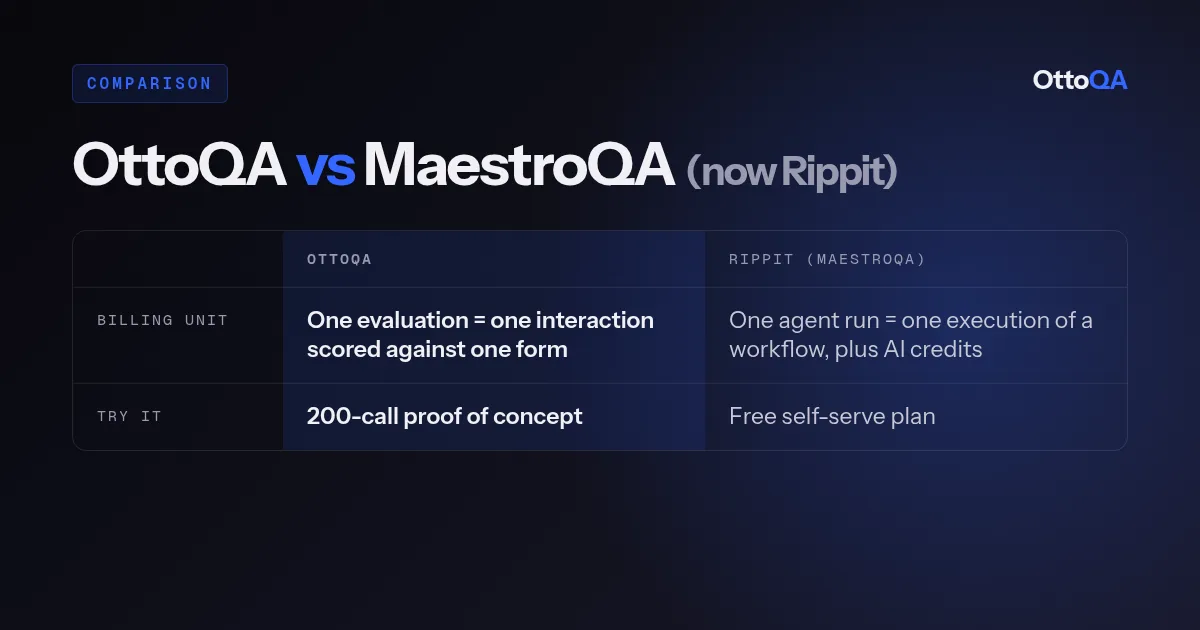
| Billing unit | One evaluation = one interaction scored against one form | One agent run = one execution of a workflow, plus AI credits |
| Coaching | Weekly coaching plans per agent; Redo AI role-play | Employee coaching is one of its lead use cases |
| Try it | 200-call proof of concept | Free self-serve plan |
Note that an agent run and an evaluation are different units, so the plan prices above are not directly comparable. Ask Rippit for a worked example at your volume.
What Rippit does well
Rippit has published, self-serve pricing with a real free plan, which is rare in this market. It is built for teams that want to ask many kinds of questions of their conversation data, from churn signals for customer success to bug reports for product, not only QA scores. If you run a digital support team on Intercom or Zendesk and want insights spread across the company, it is worth a look.
Where OttoQA is different
OttoQA is built around the QA form and the supervisor's week. It scores voice calls (plus chat and email) against the forms you already use, then produces coaching plans, call summaries, behavior trends and predicted CSAT and NPS. It was built inside a 600+ seat BPO, so multiple clients with different forms is the normal case. The OttoQA team does the form setup and calibration for you.
If you're a MaestroQA customer facing renewal
- Export first. Confirm you can export historical evaluations, scorecard definitions and agent-level scores, and in what format.
- Check your term. Know your renewal date and the notice period before auto-renewal.
- Re-price at your volume. Your old plan may have been per seat. Model the new agent-run pricing against your real conversation volume.
- Confirm voice support. If most of your volume is phone calls, confirm how calls get into the platform and who builds that connection.
- Run a side-by-side. Score the same set of already-graded calls in Rippit and any alternative before you decide.
Enterprise or small and mid-size?
For enterprise contact centers (roughly 500+ agents, often multi-site and regulated): Rippit offers a custom Enterprise tier with SSO, and suits companies that want conversation insights shared across support, product and customer success. OttoQA also offers custom pricing above 10,000 evaluations a month for large voice operations that want focused QA.
For small and mid-size centers and BPOs (roughly 10 to 500 agents, OttoQA's core customer): Both have published pricing. Rippit's free and $185 plans suit small helpdesk-based support teams on Intercom or Zendesk. OttoQA suits small and mid-size voice contact centers and BPOs that want calls scored against their own QA forms, with setup done for them.
Which should you choose?
Choose Rippit if you're a helpdesk-based support team that wants conversation insights across CX, product and success, and self-serve usage pricing appeals to you.
Choose OttoQA if you run a voice contact center or BPO and want calls scored automatically against your own QA forms, with coaching plans every week and a 200-call proof of concept first.
Frequently asked questions
Is MaestroQA still available?
MaestroQA is now Rippit. Rippit says existing customer data, rubrics and integrations carried over to the new platform.
How much does Rippit cost?
Rippit lists a free plan with 100 agent runs a month, Starter at $185 a month for 300 runs, Growth at $495 a month for 1,000 runs, and custom Enterprise pricing. AI credits are charged at cost.
What is a good MaestroQA alternative for call centers?
For voice-heavy centers, look for tools that score calls against your existing forms. OttoQA, evaluagent and ScorebuddyCX all do this. See the 2026 roundup.
Related reading
- Call Center QA Software
- Best AI Call QA Software (2026)
- OttoQA vs CallMiner
- OttoQA vs Level AI
- OttoQA vs Observe.AI
- AI Call QA FAQ
- The Ultimate Guide to Call Center Quality Assurance
- How Many Contact Center QA Evaluations Do You Need Per Agent?
- 12 Common Call Center QA Mistakes and How to Fix Them
About the author
Tom Laird is the founder of OttoQA and CEO of Expivia, with about 30 years in contact centers. He hosts the Advice from a Call Center Geek podcast. Connect with Tom on LinkedIn.