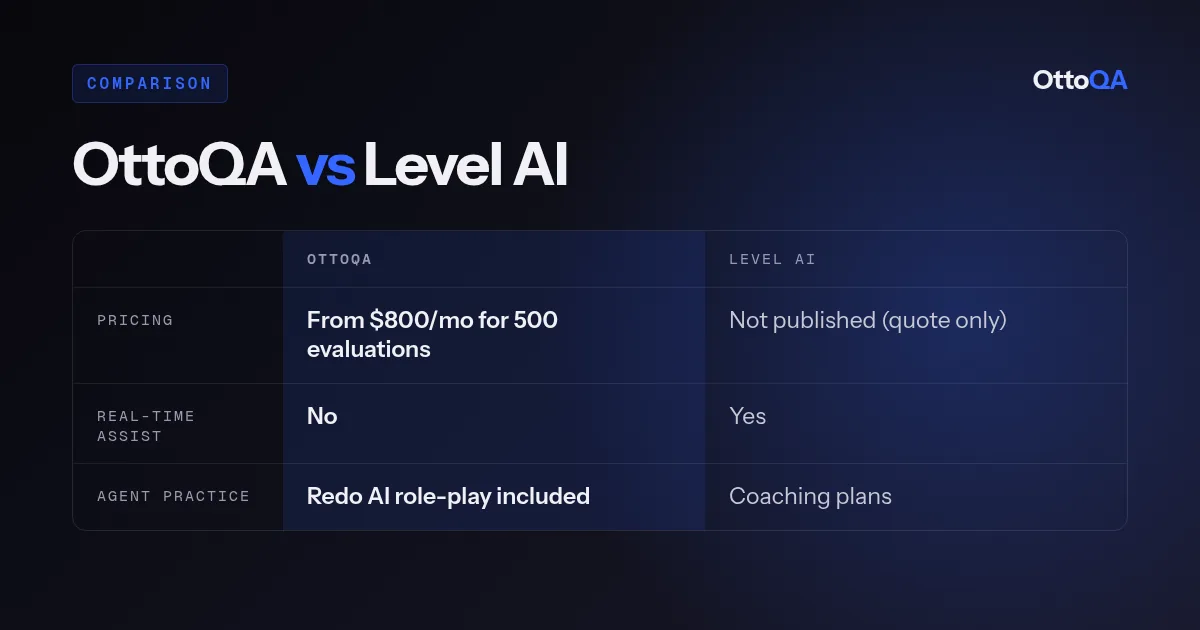
Short answer: Level AI and OttoQA both use generative AI to score conversations against your own scorecard. The difference is scope and buying model. Level AI is a suite: QA-GPT sits alongside agent assist, virtual agents, voice of customer analytics and screen recording, sold by quote. OttoQA is QA and coaching only, priced per evaluation from $800 a month, with no seat licenses and a 200-call proof of concept.
OttoQA publishes this comparison. Level AI facts come from thelevel.ai and its blog. Checked October 23, 2026.
Side-by-side comparison
| OttoQA | Level AI | |
|---|---|---|
| What it is | AI QA and coaching for contact centers | AI suite: QA, agent assist, virtual agents, VoC analytics, screen recording (thelevel.ai) |
| Scoring engine | Your form, built in by OttoQA's QA specialists and calibrated with you on 200 calls | QA-GPT, Level AI's proprietary model, scoring calls, chats, emails and bot conversations |
| Your scorecard | Yes, as written, including Excel forms | Yes, or start from a library of pre-trained questions; hybrid AI and human scorecards |
| Stated accuracy | 95% AI scoring accuracy (ottoqa.com/pricing) | "Over 90%" accuracy against a consensus of human QA managers, per Level AI's August 2023 QA-GPT launch post |
| CSAT without surveys | Predicted CSAT and NPS on scored calls | Inferred CSAT |
| Real-time assist | No | Yes |
| Agent practice | Redo AI role-play included | Coaching plans; we did not find a role-play product on its public pages |
| Pricing | From $800/mo for 500 evaluations; $1,000 one-time setup; month to month (ottoqa.com/pricing) | Not published (quote only) |
| Proof of concept | 200 calls, covered by setup | Not published; offers a sandbox for testing rubrics |
What Level AI does well
Level AI's scorecard mechanics are thoughtful. Questions can be set to N/A automatically by call type or department, so a billing call isn't marked down for skipping a sales offer. Each auto-score shows the transcript quote and timestamp behind it. When an evaluator overrides a score, the correction feeds back into future scoring. Hybrid scorecards let AI handle objective questions like the greeting or identity verification while humans score subjective ones, with both rolling into one score.
The other strength is breadth. If you want QA, real-time agent assist, AI virtual agents and voice of customer analytics on a single platform and contract, Level AI offers that. It lists GDPR, HIPAA, SOC, PCI and ISO 27001 compliance.
Where OttoQA is different
Done for you, not configured by you
You email OttoQA your QA forms. The team converts every question, calibrates on 200 of your calls, and hands you a working system. You don't need a QA admin to learn a rubric builder.
A price you can see before the demo
OttoQA's pricing page has a calculator: enter evaluations per month and get a price, with 5% off for 6-month terms and 10% off for 12. Every feature is in every plan.
Built by operators
OttoQA was built inside Expivia, a 600+ seat BPO in Erie, PA, for its own multi-client operation. Multiple clients with different forms on one platform is the default use case, not an enterprise add-on.
Enterprise or small and mid-size?
For enterprise contact centers (roughly 500+ agents, often multi-site and regulated): Level AI is usually the stronger fit if you want one vendor for QA, real-time agent assist, screen recording, AI virtual agents and voice of customer analytics, with the security and compliance coverage large buyers require.
For small and mid-size centers and BPOs (roughly 10 to 500 agents, OttoQA's core customer): OttoQA is usually the stronger fit. You get form-based QA and weekly coaching without paying for a suite you won't use, with a published price, no seat licenses and month-to-month terms. Mid-size enterprises that only need QA can also start with OttoQA and add other tools later.
Which should you choose?
Choose Level AI if you want one vendor for QA, real-time agent assist, screen recording and AI virtual agents, and you are comfortable with quote-based enterprise buying.
Choose OttoQA if QA and coaching are the problem you need solved, you want published usage-based pricing with no seat licenses, and you want proof on 200 of your own calls before committing.
Frequently asked questions
What is QA-GPT?
QA-GPT is Level AI's proprietary generative AI model for scoring conversations against QA scorecards. In its August 2023 launch post, Level AI said QA-GPT is trained on contact center data and, in its own testing, covered over 85% of scorecard questions out of the box. Its current QA page says QA-GPT evaluates over 90% of the standards and metrics scorecards cover.
How much does Level AI cost?
Level AI does not publish pricing. Contact Level AI for a quote.
Which is more accurate?
Both publish their own figures, measured on their own data. The fair test is to score the same 100 to 200 already-graded calls with each tool and compare agreement question by question.
Related reading
- Call Center QA Software
- Best AI Call QA Software (2026)
- OttoQA vs CallMiner
- OttoQA vs Observe.AI
- OttoQA vs MaestroQA (Rippit)
- AI Call QA FAQ
- The Ultimate Guide to Call Center Quality Assurance
- How Many Contact Center QA Evaluations Do You Need Per Agent?
- 12 Common Call Center QA Mistakes and How to Fix Them
About the author
Tom Laird is the founder of OttoQA and CEO of Expivia, with about 30 years in contact centers. He hosts the Advice from a Call Center Geek podcast. Connect with Tom on LinkedIn.